

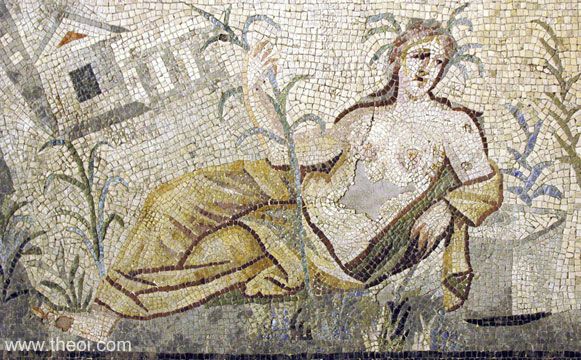
NAIADES (Naiads) were the nymphs of rivers, streams, lakes, marshes, fountains and springs. They were minor goddesses who attended the assemblies of the gods on Mount Olympos.
The Naiad nymphs were sometimes classified by domain:--
(1) Pegaiai (Pegaeae) were the nymphs of springs;
(2) Krenaiai (Crenaeae) were naiads of fountains;
(3) Potameides presided over rivers and streams;
(4) Limnades and Limnatides inhabited lakes; and
(5) Heleionomai were the nymphs of marshes and wetlands.
Naiades, in conjunction with the goddess Artemis, were nurses of the young and the protectors of girls, overseeing their safe passage from child to adult. Apollon and the River Gods were the complimentary guardians of boys.
In myth many Naiades were the wives of kings and hold a prominent place in the royal genealogies. Others, such as the beautiful daughters of the River Asopos, were loved by the gods. They often gave their names to towns, cities and islands, and as such were surely regarded as the goddess-protectors of a settlement's main water supply such as a spring, fountain, or well.
Of the various types of Naiad, the Pegaiai (of Springs) and the Krinaiai (of Fountains) were the ones most often individualised and worshipped. Those whose waters were believed to possess some special property might even have proper shrines and cults. Examples of these include the Anigrides of Elis whose waters were believed to cure disease and the Nymphs of Mount Helikon and Delphoi whose springs were thought to be fonts of poetic and prophetic inspiration.
The Naiades were depicted as beautiful young women, usually seated, standing or reclining beside a spring, and holding a water-jug (hydria) or a frond of lush foliage.
NAIADES. Nymphs of the watery element. The rivers were represented by the Potameides (Potamêïdes), who, as local divinities, were named after their rivers, as Acheloides, Anigrides, Ismenides, Amniisiades, Pactolides. (Apollon. Rhod. iii. 1219; Virg. Aen. viii. 70; Paus. v. 5. § 6, i. 31. § 2; Callim. Hymn. in Dian. 15; Ov. Met. vi. 16; Steph. Byz. s.v. Amnisos.)
But the nymphs of fresh water, whether of rivers, lakes, brooks, or wells, are also designated by the general name Naiades, Nêïdes, though they have in addition their specific names, as Krênaiai, Pêgaiai, Heleionomoi, Limnatides, or Limnades. (Hom. Od. xvii. 240; Apollon. Rhod. iii. 1219; Theocrit. v. 17; Orph. Hymn. 50. 6, Argon. 644.)
Even the rivers of the lower regions are described as having their nymphs; hence, Nymphae infernae paludis and Avernales. (Ov. Met. v. 540, Fast. ii. 610.) Many of these presided over waters or springs which were believed to inspire those that drank of them, and hence the nymphs themselves were thought to be endowed with prophetic or oracular power, and to inspire men with the same, and to confer upon them the gift of poetry. (Paus. iv. 27. § 2, ix. 3. § 5, 34. § 3; Plut. Aristid. 11; Theocrit. vii. 92.)
Inspired soothsayers or priests are therefore sometimes called numphogêptoi. (Plat. Phaedr. p. 421, e.) Their powers, however, vary with those of the springs over which they preside; some were thus regarded as having the power of restoring sick persons to health (Pind. Ol. xii. 26; Paus. v. 5. § 6, vi. 22. § 4); and as water is necessary to feed all vegetation as well as all living beings, the water nymphs (Hydriades) were also worshipped along with Dionysus and Demeter as giving life and blessings to all created beings, and this attribute is expressed by a variety of epithets, such as karpotrophoi, aipolikai, nomiai, kourotrophoi, &c.
As their influence was thus exercised in all departments of nature, they frequently appear in connection with higher divinities, as, for example, with Apollo, the prophetic god and the protector of herds and flocks (Apollon. Rhod. iv. 1218); with Artemis, the huntress and the protectress of game, for she herself was originally an Arcadian nymph (Apollon. Rhod. i. 1225, iii. 881; Paus. iii. 10. § 8); with Hermes, the fructifying god of flocks (Hom. Hymn. in Aphrod. 262); with Dionysus (Orph. Hymn. 52; Horat. Carm. i. 1. 31, ii. 19. 3); with Pan, the Seileni and Satyrs, whom they join in their Bacchic revels and dances.
