

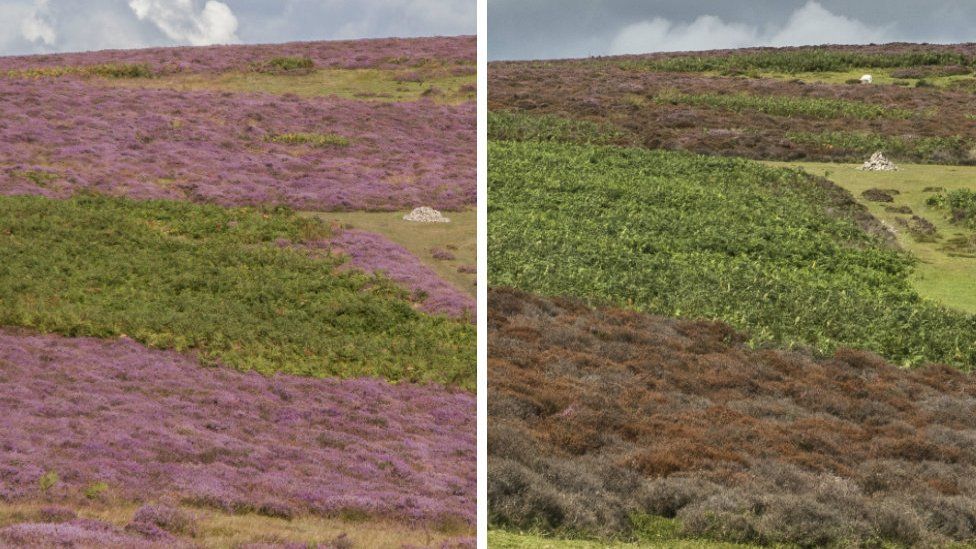
Climate change is turning hillside heather from purple to brown, the National Trust says.
Acres of heather on the Long Mynd, in Shropshire, and Holnicote, on Exmoor, have suffered due to last year's hot, dry weather and an increase in pests caused by the following mild winter.
This has a knock-on effect on wildlife such as red grouse and emperor moths, whose caterpillars feed on the plants.
It is hoped "careful management" will allow the heather to recover.
The National Trust said up to 75% of the plant on both sites, which are in its care, was in poor health this year.
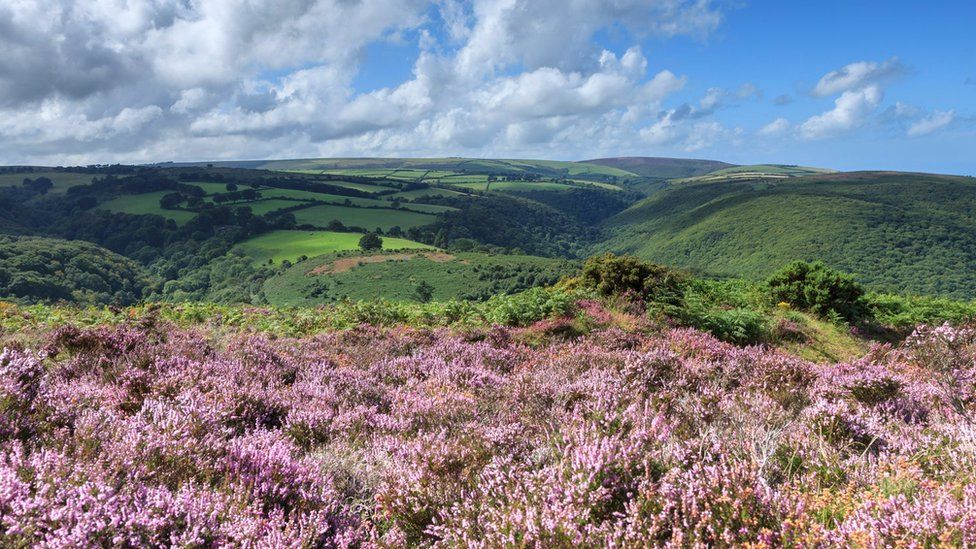
In Previous Years Purple Heather has Bloomed Across the Hillsides
A prolonged hot summer in 2018 restricted water to the heather, while a lack of rain through the winter and first half of this year also took its toll.
The milder winter also boosted beetle numbers. The insects damage the heather's outer leaves and make it more susceptible to drought stress, the trust said.
Peter Carty, from the trust in Shropshire, said: "In places where heather was sheltered... or where damp conditions were present, the heather has survived.
"However, there will be no mass flowering this year."
Keith Jones, climate change specialist at the trust, said: "We are seeing first-hand the impacts of climate change on at least two of these special landscapes within our care."
