

Tiny island in Bristol Channel has 25,000 Manx shearwaters – 95% of England’s breeding population – and 1,335 puffins
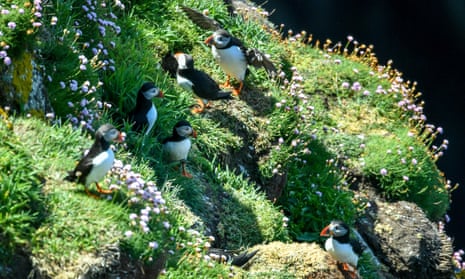
Puffins on Lundy in the Bristol Channel. A drive to remove rats from the island has helped numbers. Photograph: Ben Birchall/PA
There are more seabirds nesting on the island of Lundy than at any time since the 1930s, conservationists have revealed.
The tiny island in the Bristol Channel, a globally famed location for Britain’s seabirds, is now home to 25,000 Manx shearwaters – 95% of England’s breeding population – as well as 1,335 puffins and more than 150 pairs of storm petrels, a species that only arrived on the island in 2014.
Despite the recent threat of avian flu, which has decimated wild bird populations in some of the world’s most sensitive locations, and the problematic decline in wild sources of food such as sand eels, the total number of seabirds on Lundy stood at 40,000 this summer.
This is a massive turnaround after just 7,351 remained in 2000. Puffins were close to extinction, with just 13 counted on the windswept 450-hectare island in 2001.
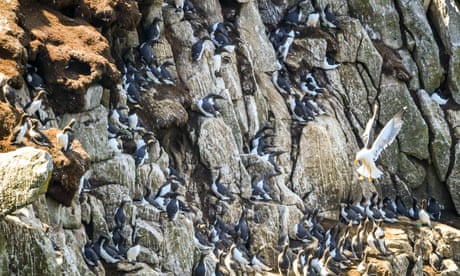
But a drive to remove rats from the island has helped numbers to rebound. Black and brown rats, which arrived on Lundy as stowaways on ships over many decades, had been preying on the eggs and chicks, particularly those of burrow-nesting shearwaters and puffins.
The rats were eradicated in a partnership led by the RSPB, Natural England, the Landmark Trust and the National Trust between 2002 and 2004 – a move that was opposed at the time by some animal rights groups, who argued that conservationists were favouring tourist-friendly birds over the rats.
Since the island was declared rat-free in 2006, its seabird populations have bounced back, as they have on other small islands when invasive predators let loose by humans have been removed.
Paul St Pierre, a conservation officer for the RSPB, said: “Partnership projects like this show just how much potential there is to restore species and landscapes on an incredible scale.
“If we can restore over 30,000 birds to one small island in the Bristol Channel, just imagine how much could be achieved if everyone came together to restore nature right across the UK.”

Ongoing biosecurity work has ensured no rats have returned to Lundy on boats, while annual surveying has revealed the dramatic population recovery.
Global populations of seabirds have fallen by 70% since the 1950s, and in northern Britain most seabird populations have experienced significant declines in recent years. But more southerly summer populations of seabirds that feed in the waters off south Wales and south-west England have largely bucked this downward trend.
Derek Green, the general manager of Lundy, said: “We’re delighted by the dramatic increase of seabirds on Lundy in recent years. Conservation is at the heart of everything we do on the island and we look forward to continuing to nurture this very special place for future generations to enjoy.”
British coasts are internationally important for many species including puffins, grey seals and Manx shearwaters, with more than 80% of the world’s population nesting in the country.
The revival recalls the abundance of the 1930s: in 1939 it was estimated that Lundy was home to 80,000 seabirds.
… there is a good reason why not to support the Guardian.
Not everyone can afford to pay for news right now. That is why we keep our journalism – including our essential reporting on the natural world – open for everyone to read. If this is you, please continue to read for free.
But if you are able to, then there are three good reasons to support us today.
1. Daily environmental journalism is a powerful reminder of the damage being done to wildlife, plants and habitats – and the people impacted and displaced by our changing planet.
2. Independent journalism amplifies the latest science, data and studies, and puts pressure on policymakers and businesses to take action.
3. Our work foregrounds solutions that encourage the innovation and investment in new technologies that we so desperately need.
At the Guardian, we have environment reporters stationed globally. We have renounced advertising from fossil fuel companies and have significantly cut our own carbon emissions.
Help power the Guardian’s journalism for the years to come, whether with a small sum or a larger one. If you can, please support us on a monthly basis from just £2. It takes less than a minute to
