

Wang Danhong during an Anhui Opera performance in 2011. [Zhang Jing / for China Daily]Although it's one of China's oldest and most famous traditional art forms, a lack of exposure and opportunity, and an aging cast of performers mean Anhui Opera may soon face the final curtain, as Zhu Lixin and Ma Chenguang report from Hefei.
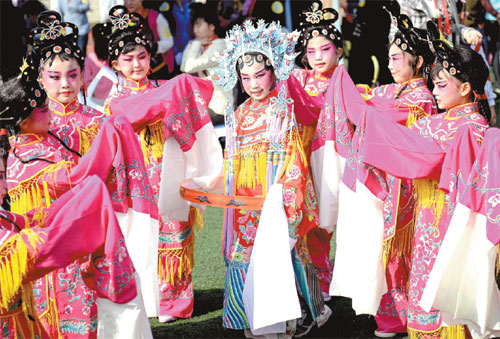
Primary school students showcase what they have learned at an Anhui Opera talent class at an educational event in Hefei, Anhui province, in 2014. [Zhang Duan / Xinhua]
In 1790, Imperial China was ablaze with excitement about the 80th birthday of the Qianlong Emperor, and artists, entertainers, actors, dancers and performers from across the country were ordered to travel to Beijing and help celebrate the momentous event. Four opera troupes from East China's Anhui province were among the performers the emperor had commissioned, and when the celebrations finally came to an end, they decided to remain in the capital.
The decision was to prove a seminal moment in the evolution of one of China's most widely recognized cultural treasures: In the late 1820s, the troupes began giving joint performances with the best troupes in Hubei province and eventually developed the style that modern-day devotees recognize as Peking Opera.
This year marks the 225th anniversary of the troupes' participation, and in memory of their achievements and contribution to Chinese life, Anhui's cultural department arranged a monthlong celebration that culminated with the province's best opera troupes performing in Beijing.
One of the troupes performed The Psycho, "Jinghunji" in Chinese, an adapttion of Macbeth, one of Shakespeare's darkest and most powerful works. Set in Scotland, the play illustrates the damaging physical and psychological effects of political ambition on those who seek power for its own sake.
The adaptation, which premiered in 2013 after more than a year in preparation, is set in China during the Spring and Autumn Period (770 - 476 BC), and although some minor changes were required to make the story better fit the Chinese background, the plot remains faithful to the original.
Producer Li Longbin said the adaptation was partly aimed at the younger generation and foreigners, because while Peking Opera is revered as China's "national essence", Anhui Opera is on the verge of dying out.
Change and decline
Before the founding of the People's Republic of China in 1949, Anhui Opera was known as "Hui-diao", which translates loosely as "Anhui tune", but that was changed to "Huiju", meaning "Anhui Opera". In 1956, the Anhui Provincial Opera Troupe of Anhui Opera was established, and it trained dozens of famous artists, some of whom performed for former top leaders, such as Chairman Mao Zedong, and won great acclaim.
Zhang Qixiang, 71, one of the best-known "first-generation" of Anhui Opera performers, has expressed his concerns about the state of the form on many occasions. Nine years ago, he told a local newspaper, "The provincial troupe has been serving as a brand, but we don't have enough products to make the brand memorable to the audience".
It seems that Zhang was right to be worried:
The Psycho is one of just a handful of new works that have been created specifically for the genre since he gave that interview in 2006.
The dearth of new works has led to fewer performances and, inevitably, lower standards. "As a result, actors and actresses don't have enough chances to practice on stage", said Wang Danhong, an Anhui performer, who has garnered praise both in China and internationally for more than 30 years. She has won China's most-prestigious drama award, the Chinese Plum Award, and is seen as an "inheritor" of Anhui Opera, which was listed as part of the nation's intangible cultural heritage in 2006.
"I think I was born to perform Anhui Opera - which has brought me so many honors in the past 30 years - so I have to do something to save the form from dying out," she said.
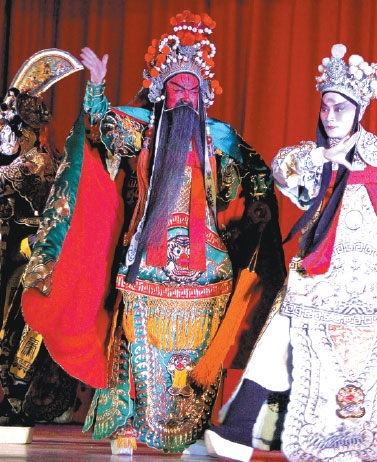
Anhui Opera artists perform for overseas Chinese in New York during a tour of the US in 2013. [Wang Chengyun / Xinhua]
In 1982, Wang, then just 14, was one of 45 students admitted to the Anhui School of Art to study the provincial opera form. They were regarded as the second generation of Anhui Opera artists, following Zhang and his peers, but now fewer than 10 of them are still engaged in the art form.
Three years later, the provincial troupe recruited Wang, who was a student at the time, to play a number of roles in their programs. It was the start of her professional career.In 1982, Wang, then just 14, was one of 45 students admitted to the Anhui School of Art to study the provincial opera form. They were regarded as the second generation of Anhui Opera artists, following Zhang and his peers, but now fewer than 10 of them are still engaged in the art form.
In 1990, to mark the 200th anniversary of the original troupes' journey to Beijing, the central cultural authorities arranged for troupes from all the major Chinese operatic forms to perform in the capital. Wang was chosen to perform The Drunken Concubine, also a Peking Opera favorite, which was regarded as a great honor.
"In the mid-1990s, new cultures started to influence China with unprecedented speed," Wang said, referring to a period when she first began to sense that the general public was falling out of love with traditional Chinese opera. Her career stalled, mainly because there were so few opportunities to perform, and most chances came via gala events, which were few and far between. "To help Anhui Opera, new measures have to be taken to attract larger audiences, especially younger people. Young people don't hate the opera, they just don't get enough chances to appreciate it," she said.
However, other provinces have now taken the lead in protecting traditional opera forms. Despite its long history and the fame of its star performers, Anhui Opera has been relegated to the "graveyard shift" on local TV, which broadcasts a program at 8 am, when most people are either on their way to work or busy preparing for the day ahead.
The lack of media presence is compounded by a decline in the number of people who understand and appreciate the form, "not to mention those who love it", Zhang said.
The new generation
In 1997, Wang was accepted by the Central Academy of Drama in Beijing. She studied there for two years until she was recruited by a Swiss opera troupe, where she performed a wide range of roles in both Western and Anhui opera. Eventually though, she decided to return to Anhui.
In 2005, the Anhui Opera Troupe and the Peking Opera Troupe were reorganized into a new single entity called the Anhui Provincial Troupe of Anhui Opera and Peking Opera. The following year, the Anhui troupe recruited dozens of students for a five-year training program. They are the third generation of artists from the province.
"They spend half their time studying Peking Opera, and the other half doing Anhui Opera. I have to doubt the effect of such a training model," Wang said. "Although they share many similarities, Anhui Opera and Peking Opera are still two different genres, so I think the training courses will not be able to breed real talent.
"Nowadays, all the best Anhui Opera artists - and there aren't too many of them - are older than 40," Wang said, adding that talented young performers seem to be in short supply.
She was deeply concerned about the future. "Once my generation has retired from the stage, Anhui Opera may eventually die out. The first generation would be too old to teach courses, and the good times for us - the 'second generation' - may end soon. A lack of opportunity to practice may mean that the third generation, all of whom are still very young, may not progress," she said.
As a member of the Provincial Committee of the Political Consultative Conference, Wang has repeatedly called for greater protection for Anhui Opera. She has also submitted a number of proposals and suggested the establishment of a professional teaching team to raise the level of training.
"We should try hard to protect classic and traditional Anhui Opera programs and make full use of them, but whether the art form can survive the current difficulties depends on the measures taken," she said.
Ji Guoping, vice-chairman of the Chinese Dramatists Association, said adapting Western plays is an innovative way of reviving traditional operas, and called for a greater range of measures to be employed to ensure the survival of the Anhui form. "Adaptations are a perfect combination of tradition and innovation. They give us an effective way of reviving and promoting Chinese opera to a much wider audience," he said.
By Zhu Lixin and Ma Chenguang(
Contact the writers through This email address is being protected from spambots. You need JavaScript enabled to view it.
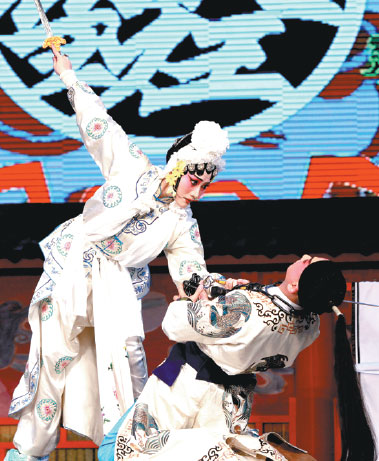
Wang Danhong during an Anhui Opera performance in 2011.
[Zhang Jing / for China Daily]
